Metal cleaning is a process that aims to remove organic contaminants, such as oils, greases, etc., and solid residues, such as metal swarf, dust, abrasives, etc., that have been deposited on the surface of the parts following their production, processing, and/or treatment.
Cleaning is a fundamental stage of the production process, with consequences not only for the following processing and/or assembly, but also for the functionality and quality of the final product.
What can be cleaned? EVERYTHING!
There are many fields of application: below are some of the most common processes from which the parts to be cleaned mostly come from.
ILSA-MC manufactures specific lines of systems that work with different families of cleaning products, thus providing customers with a wide range of choices to find the most suitable solution for the parts to be treated and the contaminants to be removed.
| Modified Alcohols |
Aliphatic Hydrocarbons |
Chlorinated Solvents |
Fluorinated Solvents |
|
|---|---|---|---|---|
| Density [kg/L] | 0,88 | 0,77 | 1,62 | 1,30 |
| Vaporization heat [kJ/kg K] | 1,98 | 2,21 | 0,88 | 1,34 |
| Specific heat [J/g] | 320 | 260 | 240 | 261 |
| Boiling point [°C] | 161 | 180 | 121 | 48 |
| Flash point [°C] | 61 | >61 | - | - |
| Vapor tension at 20°C [mB] | 1,3 | 1 | 19 | 350 |
| Surface tension at 25°C [mN/m] | 26,1 | 25,1 | 32 | 21,7-24 |
| Kauri-butanol index (Kb) | >200 | 29 | 90 | 118 |
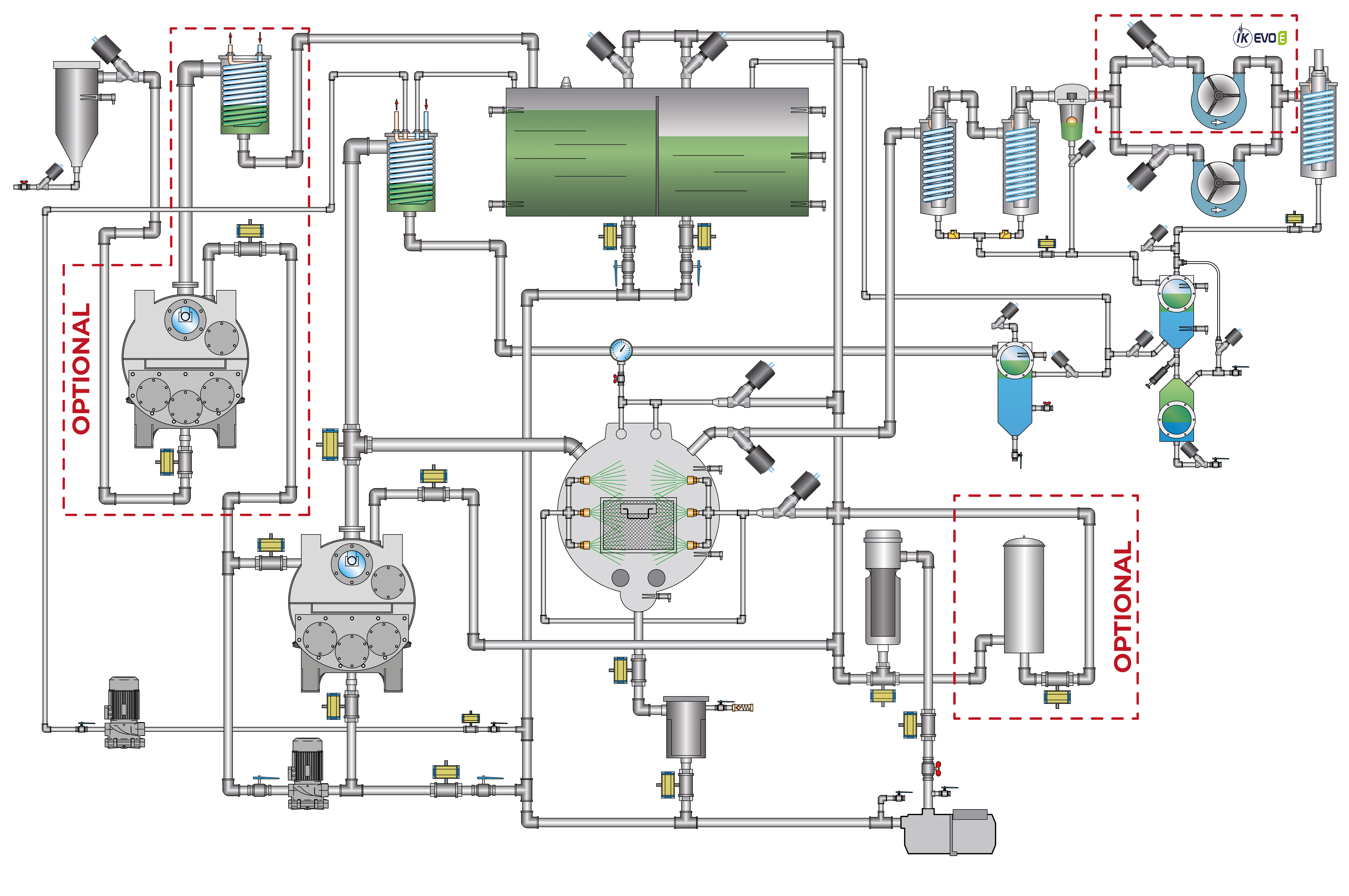
The cleaning cycle can be structured in different ways, combining different cleaning actions to allow the solvent to mix with organic contaminants and to mechanically remove solid particles. These phases can be identified as spraying (pre-cleaning), total immersion, ultrasound, high-pressure lateral flows, degreasing with solvent vapors, and complete drying. If necessary, after cleaning, a protective oil can be applied to materials subject to oxidation.
The parts to be cleaned are generally placed in the machine using special baskets/frames of various shapes and sizes. Depending on the characteristics of the products and the baskets/frames, the parts can be placed in bulk, positioned or fixed, to allow load movement even in the presence of delicate parts. To keep the items in the loading position, to secure them, or simply to limit their movement, partializing covers or specific positioning supports (pins) can be used.
The baskets containing the parts generate “the load” with various combinations to
optimize the use of the total volume of the treatment chamber.
Once introduced, the load is fixed, automatically or manually, inside the machine.
The load can be inserted and extracted manually, with the aid of roller conveyors and platforms, or by combining the machine with an
automatic or robotic system, optionally complete with buffers, both at the entrance for dirty parts and at the outlet for clean parts.
Depending on the requirements and characteristics of the parts, the load in the machine can be rotated 360° on the horizontal axis,
tilted at adjustable speeds and angles, or kept static. The rotation and tilting modes are freely programmable, as is the option to keep the load stationary.
This solution allows for uniform movement and exposure of the load to the cleaning cycle phases, even in multi-basket configurations.
The machine can be equipped with an upper closure lid system to eliminate the need to insert covers
for each load (depending on the size of the parts being processed); some machine models have this system as standard equipment.
The solvent removes impurities from the parts and for that reason becomes contaminated with them.
In ILSA-MC' machines, specific devices and programs allow the liquid itself to be kept in optimal condition at all times.
Special filters of different types and capacities are used, capable of retaining dirt particles such as chips and dust,
while oils and greases are separated from the solvent thanks to the integrated and continuous distillation.
Even the water introduced by processing emulsions or simply condensed from the air sucked into the machine
to create vacuum, is separated from the cleaning solvent in a special container.
The cleaning cycle is programmed and controlled by a Siemens PLC and a in-house developed software for use on ILSA-MC cleaning systems.
All functional aspects and information relating to the system can be managed (event history, alarm history, cycle history, set-up, maintenance programs, etc.).
All these activities can also be carried out via Ethernet, which allows you to take advantage of the online assistance service.
ILSA-MC is also able to supply all the devices and services required to create a turnkey package for the control and management of cleaning systems.
ILSA-MC has always placed the optimization and improvement of the highest standards of safety and environmental protection,
and therefore compliance with the regulations governing the use of cleaning systems, at the center of its research and development activities.
An example of its focus on energy consumption, and therefore on the environment, is the system called "ILSA-MC OE", which, through
appropriate hydraulic design and automatic software management, allows the solvent vapors generated in the distiller to be managed and used
both for the degreasing phase and for heating the system, reducing both electricity consumption and the energy used
to condense the vapors themselves.
The “Plug&Play” configuration integrates a condensation system with an air exchanger that eliminates any
type of external water connection for cooling or additional devices such as chillers or cooling towers.
Through the use of special automatic maintenance cycles and careful design and logic, ILSA-MC ensures
that solvent emissions are reduced as much as possible: filters are dried and drained before cleaning and being replaced;
the condensation system guarantees emissions into the atmosphere well below regululations' limits.
Lower emissions and lower consumption translate into respect for the environment, less solvent waste, and lower plant operating costs.

 Italiano
 English
 Français
 Deutsch
 Español